
The environment’s falling apart, and one of the major causes is the burning of fossil fuels. Well, this wouldn’t be the case if less fossil fuels were burned, right? This is exactly the message we are trying to convey to everyone. If more and more fossil fuels get burned the more the environment gets scarred. In our research we have come up with good and superior alternatives for fossil fuels, which are eco-friendly. Our group’s main goal is to make people realize how badly damaged the environment is and if we do nothing eventually nature will turn her back on us. If we let the environment get ruined the entire planet will eventually die, and that’s the main reason for our advocacy. Hopefully the message that we are conveying will give a new light to saving the environment.
Sunday, January 25, 2009
The Inconvenient Truth About Fossil Fuels
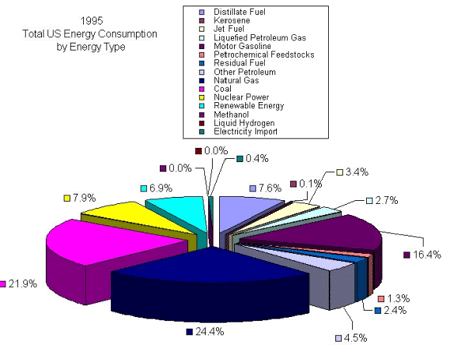
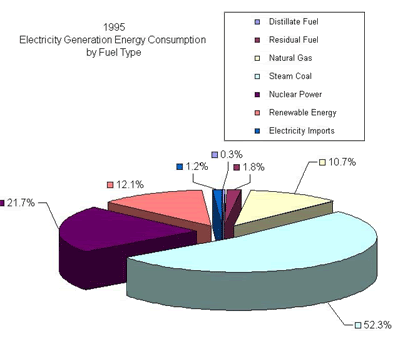
Fossil fuels, coal, oil and natural gas, are a non-renewable source of energy. Formed from plants and animals that lived up to 300 million years ago, fossil fuels are found in deposits beneath the earth. The fuels are burned to release the chemical energy that is stored within this resource. Energy is essential to modern society as we know it. Over 85% of our energy demands are met by the combustion of fossil fuels. These two pie charts show exactly how vital fossil fuels are to our society by showing how much of each energy resource is consumed.
Formation
Going back to the earlier days of Earth, the plants and animals that lived then eventually died and decomposed. The majority of these life forms were phytoplankton and zooplankton. When these ancient ocean dwellers died, they accumulated on the bottom of a seabed; this is how a good portion of our fossil fuel reserves began. The actual transformation process of these prehistoric creatures is not known, but scientists do know that the pressure, heat, and a great deal of time go into the making of fossil fuels.
Geologists are fairly certain that the beds of organic remains mixed with silt and mud to form layers. Over time, mineral sedimentation formed on top of the organisms, effectively entombing them in rock. As this occurred, pressure and temperature increased, these conditions, and possibly other unknown factors, caused organic material to break down into the simpler form of hydrocarbons: chains of carbon and hydrogen ranging from simple configuration to complex compounds. Another affect of extreme pressure is that the oil and gas which are various mixtures of hydrocarbons migrate upwards to the surface. Exactly when in the conversion process and the nature of this migration is not known and is subject to conjecture.
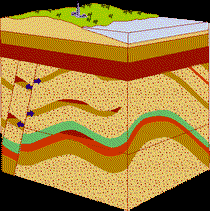
Oil and gas are found in the ground, not freely drifting up through the earth. This is because the hydrocarbons come across rock formations that they are unable to penetrate. Complex rock structures that effectively trap gas and oil are formed by tectonic plate activity, the same forces that shift continents. The most common formation that accomplishes this is called an anticline, a dome or arched layer of rock that is impermeable by oil and gas. Underneath this barrier, a reservoir builds up. An oil reservoir is not some vast underground lake, but rather a seemingly solid layer of rock that is porous. Oil fields have been found everywhere on the planet except for the continent of Antarctica.
These fields always contain some gas, but this natural gas, methane, does not take nearly as long to form. Natural gas is also found in independent deposits within the ground as well as from others sources too. Methane is a common gas found in swamps and is also the byproduct of animals' digestive system. Incidentally, Methane is also a greenhouse gas.
Coal is formed just like the other fossil fuels, though it goes through a different process, coalification. Coal is made of decomposed plant matter in conditions of high temperature and pressure, though it takes a relatively shorter amount of time to form. Coal is not a uniform substance either; its composition varies from deposit to deposit. Factors that cause this deviation are the types of original plant matter, and the extent the plant matter decomposed. There are over 1200 distinguishable types of coal. Coal begins as peat, a mass of dead and decomposing plant matter. Peat itself has been used as fuel in the past, as an alternative to wood. Next, the peat becomes lignite, a brownish rock that contains recognizable plant matter and has a relatively low heating value. Lignite is the halfway point from peat to coal. The next phase is sub bituminous. A shade of dull black, showing very little plant matter, this type of coal has a less than ideal heating value. Bituminous coal is jet black, very dense, and brittle. This type of coal has high heating value.
The main point of this is that all of these fossil fuels are made of hydrocarbons. It may come as a surprise that these two elements, hydrogen and carbon, can create many, many different compounds with unique characteristics. What makes hydrocarbons valuable to our society is the stored energy stored within them. This energy is contained in the atomic bonds. The original source of this energy is all the solar energy the prehistoric organisms trapped in their bodies eons ago. How do we make use of this bond energy then? We burn them.
Health Impact
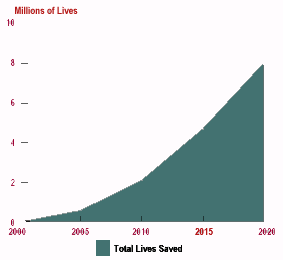
Air particles are deadly. The byproducts that form from the burning of fossil fuels are very dangerous. These small particles can exist in the air for indefinite periods of time, up to several weeks and can travel for miles. The particles, sometimes smaller than 10 microns in diameter, can reach deep within the lungs. Particles that are smaller than this can enter the blood stream, irritating the lungs and carry with them toxic substances such as heavy metals and pollutants. Over a lifetime of continued exposure, a person's ability to transfer oxygen and rid pollutants is impeded. Those affected could become afflicted with fatal asthma attacks and other serious lung conditions. the World Resources Institute reports that between the years of 2000 and 2020, 8 million deaths worldwide could possibly occur without changing present conditions. In 1990 alone, respiratory diseases were a leading cause of disabilities and illnesses worldwide. This is a global problem and requires a global solution. Because the contamination is growing at an exponential rate, minor reductions now will greatly reduce the number of lives lost in the future.


No comments:
Post a Comment