The environment’s falling apart, and one of the major causes is the burning of fossil fuels. Well, this wouldn’t be the case if less fossil fuels were burned, right? This is exactly the message we are trying to convey to everyone. If more and more fossil fuels get burned the more the environment gets scarred. In our research we have come up with good and superior alternatives for fossil fuels, which are eco-friendly. Our group’s main goal is to make people realize how badly damaged the environment is and if we do nothing eventually nature will turn her back on us. If we let the environment get ruined the entire planet will eventually die, and that’s the main reason for our advocacy. Hopefully the message that we are conveying will give a new light to saving the environment.
Friday, February 27, 2009

Saturday, February 21, 2009
Different Hydroelectric Power Plants in the Philippines
This is a list of the different Hydroelectric Power Plants in the Philippines. There are a lot of power plants in different areas of Luzon, Visayas and Mindanao. Some are already decommissioned, but most are still functional today. There are different types of power plants: Dam-Type, Run-off, Pump Storage and others.
| Plant Name | Location | Capacity (MW) | Current Owner | Date Commissioned | Remarks |
|---|---|---|---|---|---|
| Large Hydro | |||||
| Luzon | |||||
| Ambuklao | Benguet | 75 | SN-Aboitiz Power | 1956 | decomissioned |
| Angat | Bulacan | 246 | NPC | 1967 - 1993 | Dam Type |
| Bakun | Ilocos Sur | 70 | Luzon Hydro Corp | 2001 | Run - off / NPC-IPP |
| Binga | Benguet | 100 | SN-Aboitiz Power | 1960 | Dam Type |
| Casecnan | Nueva Ecija | 140 | CalEnrgy | 2001 | Run - off / NPC-IPP |
| Kalayaan | Laguna | 684.6 | Jpower & Sumitomo | 1982 / 2002-2004 | Pump Storage/NPC-IPP |
| Magat | Isabela | 360 | SN-Aboitiz Power | 1983 | Dam type |
| Pantabangan | Nueva Ecija | 100 | First Gen Hydro Power Corp | 1977 | Dam Type |
| San Roque | Pangasinan | 340 | Marubeni/Sithe | 2003 | Dam type / NPC-IPP |
| Mindanao | |||||
| Agus 1 | Lanao del Sur | 80 | NPC | 1992-94 | |
| Agus 2 | Lanao del Sur | 180 | NPC | 1979 | |
| Agus 4 | Lanao del Norte | 158.1 | NPC | 1985 | |
| Agus 5 | Iligan City | 55 | NPC | 1985 | |
| Agus 6 | Iligan City | 200 | NPC | 1953-77 | |
| Agus 7 | Iligan City | 54 | NPC | 1982-83 | |
| Pulangi IV | Bukidnon | 255 | NPC | 1985-86 | Dam Type |
| Small Hydro/Minihydro | /td> | ||||
| Luzon | |||||
| Caliraya | Laguna | 22.6 | Jpower & Sumitomo | 1942-50/ 2002 | NPC - IPP |
| Botocan | Laguna | 20.8 | Jpower & Sumitomo | 1946-48/ 2003 | NPC - IPP |
| Masiway | Nueva Eciya | 12 | First Gen Hydro Power Corp | 1980 | Dam Type |
| Baligatan | Isabela | 6 | NIA | 1987 | Feeding from Magat |
| Barit | Camarines Sur | 1.8 | People's Energy Services | 1957 | |
| Palakpakin | Laguna | 0.56 | Philpodeco | 1933-38 | |
| Balugbog | Laguna | 0.55 | Philpodeco | 1933-38 | |
| Cawayan | Sorsogon | 0.4 | Sorsogon Electric Cooperative II | 2002 | |
| Kalibato | Laguna | 0.075 | Philpodeco | 1933-38 | |
| Magat A | Isabela | 1.44 | ISELCO | 1984 | Run-off river |
| Magat B | Isabela | 1.08 | ISELCO | 1985 | Run-off river |
| Visayas | |||||
| Loboc | Bohol | 1.2 | Sta. Clara International Corporation | 1957-67 | |
| Amlan | Negros Oriental | 0.8 | NPC | 1962 | |
| Mindanao | |||||
| Bubunawan | Bukidnon | 7 | Bubunawan Power Company | 2001 | offtaker: CEPALCO |
| Talomo | Davao City | 3.5 | Hydro Electric Development Corp | 1998 | |
| Agusan | Bukidnon | 1.6 | First Gen Bukidnon Power Corp | 1957 | Run-off |
Thursday, February 19, 2009
The Alternative Energy Sources
Energy is the ability to do work. While energy surrounds us in all aspects of life, the ability to harness it and use it for constructive ends as economically as possible is the challenge before mankind. Alternative energy refers to energy sources which are not based on the burning of fossil fuels or the splitting of atoms. The renewed interest in this field of study comes from the undesirable effects of pollution (as witnessed today) both from burning fossil fuels and from nuclear waste byproducts. Fortunately there are many means of harnessing energy which have less damaging impacts on our environment. Here are some possible alternatives:
Biodiesel.Biodiesel is a fuel made from different renewable raw materials such as vegetable oils, plant oils, animal fats, or algae. It can be mixed with the now-conventional diesel or can be used by itself for use in diesel engines.
The process of making biodiesel from plant oils is called transesterification. Transesterification is a process that breaks the plant oil molecule and removes glycerin* to separate it from the alcohol ester, the biodiesel). Methanol is mixed with sodium hydroxide to make sodium methoxide. Then , the sodium methoxide is mixed with the vegetable oil. When the mixture settles, the glycerin is left on the bottom and the alcohol ester, or the biodiesel, is left on top. The biodiesel undergoes more processes for cleaning and quality control. The final product from the alcohol ester is biodiesel fuel, which burns 75% cleaner than the regular Diesel fuel. Aside from that, the remaining glycerin can be used in other products, like soaps and lubricants.
*Glycerin: Glycerin (C3H8O3) is a sweet, syrupy, colorless or yellowish liquid obtained from fats and oils by saponification. This is used as a solvent, an antifreeze, and a sweetener and in the manufacture of cosmetics, liquid soaps, inks, and lubricants.
Several countries have active programs and legislative support on the use and development of Biodiesel. Soya oil is the main feedstock used by the United States of America for Biodiesel; rapeseed oil for Europe; and palm oil for Malaysia. In some countries, edible oil is not sufficient; so inedible oils are used. One example is India, where Jatropha oil is used.
In the Philippines, biodiesel is obtained from animal manure, coconuts, rice hulls, sugarcanes, and wood wastes. These are used for commercial cooking, household cooking, industrial processes, heating, power generation, and transportation. Biodiesel is currently being used in some places in the country. Most are commercially available. Some are classified under:
- technical feasibility proven by demonstration projects
- proven competitive with conventional systems and ready for commercialization
- technical concepts/laboratory studies ongoing
The use of Biodiesel has many advantages compared to fossil fuel diesel. These advantages include:
- More security in energy supply
- Less dependence on fossil fuels
- Less harmful emissions
- Protection of soil by biodegradable products
- Less health hazard caused by toxic products
- More jobs to offer, even in rural areas
- More agricultural returns
- Development in technology
- More profits
- Less debt
Solar Power.Solar energy is the electricity generated from the sun. It is produced either by using solar panels or by using the heat of the sun to heat up a fluid used in the process of an engine or a turbine-generator.
Solar energy is used in many countries. Some countries, like the United States of America, Thailand,, and Singapore passed laws on the use of solar energy. Solar energy is usually used for street lamps and is being developed for the use in solar-powered vehicles. Many companies in the world, and also good companies from Asia and our own country, offer commercially available efficient solar at a reasonable and affordable price.
In the Philippines, a mix of big and small companies have solar panels to offer—some even have their claims on special technologies provided. Filipino engineers managed to improve the efficiency and technology of solar panels and also managed to drive down costs. With the education Filipino laborers have, private international companies, like a silicon-based company called Solaria, chose Philippines as their place of manufacturing of solar panels. This offers more job opportunities to more Filipinos.
In our country, solar energy is produced from solar insulation and solar heat. It is used for household electricity, telecommunication, water pumping, water heating, and drying of agricultural crops. All are readily available in the market and also come in free from the sun itself.
Solar energy is very advantageous because the sun is readily available during daytime. Our country is lucky to be near the equator, where more light from the sun is received. To convert this solar energy, solar panels are used. These solar panels aren’t hard to produce because they are usually made from silicon. Silicon is also abundant on Earth—it can be found almost everywhere, even at the seashore!
Hydroelectricity.Hydroelectricity is the electricity made from moving water. It is produced when the water flows through a hydraulic turbine that will spin and rotate adjacent generators to transform the rotation energy into electricity. After going through the turbine, the water will be returned to the stream or riverbed. Hydraulic turbines are generally located near dams that increase the height from which water falls to increase the potential for energy generation. Learn more about hydropower.
Monday, January 26, 2009
BioDiesel : Drive Vegan!
The price of oil today is still quite costly, even for the average Filipino. We have become too dependent on other countries to provide fuel for our cars. Perhaps the only solution to that would be to depend on our own selves to produce our own fuel.
Biodiesel is environment-friendly. Instead of crude oil, biodiesel makes use of plant oils and animal fats. It is a renewable energy, which produces fewer emissions than the standard diesel. Because of that, the amount of air pollution will decrease. Being biodegradable makes it four times faster to break down than the standard diesel. What use is that? We all remember the Guimaras oil spill, and the unfortunate effects it brought upon the inhabitants there folk. If ever an occasion like that ever arises again, the cleanup should be much easier.
When it comes to safety, it is better than the standard diesel. It burns at a higher temperature, so chances of accidental combustion are less.
Biodiesel is also good for your engine. It increases your engine life by removing wastes which may get stuck within the engine to save it from wearing out. Furthermore, it can be used in almost any diesel engine with little or no modification at all.
In 2004, President Arroyo started the energy independence project in hopes of attaining 60% energy self-sufficiency for the Philippines by 2010. Plans were made and some of these included the development of coco-biodiesel and jatropha biodiesel, besides sugarcane, corn, cassava, and soybeans. Coco-biodiesel or Coconut Methyl Ester, obviously from the name itself is a biodiesel which is derived from coconut oil. This is a good idea, since coconuts are found in many areas here in the Philippines. Aside from the other advantages a biodiesel usually has, coco-biodiesel “boosts engine power and acceleration, and improves fuel economy.” Improving the fuel economy would earn us more mileage, which can really help us economically. Other economic-related positive effects with coco-biodiesel include more jobs for people in the coconut production industry. On the other hand, jatropha or “tuba tuba” is a non-edible plant, which can produce an oil content ranging from 30% - 58%. It is easily planted, and it can even withstand droughts. “The plant remains useful for 30 - 40 years.”
With all those, why shouldn’t we convert to biodiesel? Not only is it environment-friendly, but it is also more affordable.
Sources:
http://www.doe.gov.ph/AF/Biofuels.htm
http://ezinearticles.com/?The-Advantages-of-Biodiesel&id=1090485
http://www.doe.gov.ph/AF/BiodieselFAQ%27s.htm
http://www.bioenergywiki.net/index.php/The_Philippines/
Sunday, January 25, 2009
Global Warming and its Effects
Because of the continuous consumption and combustion of fossil fuels, the earth suffers from the continuous emission of green house gases, primarily, carbon dioxide. Green house gases can stay in the atmosphere for decades, hundreds, and even thousands of years. No matter what we do, global warming is going to have some effect on Earth. Here are the 5 deadliest effects of global warming.
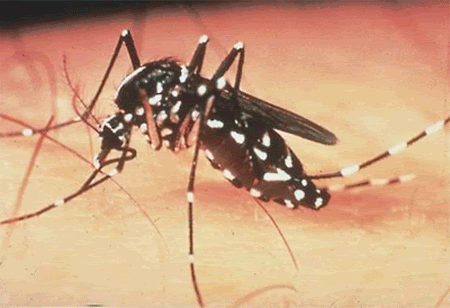
5. Spread of DiseaseAs northern countries warm, disease carrying insects migrate north, bringing plague and disease with them. Indeed some scientists believe that in some countries, thanks to global warming, malaria has not been fully eradicated.
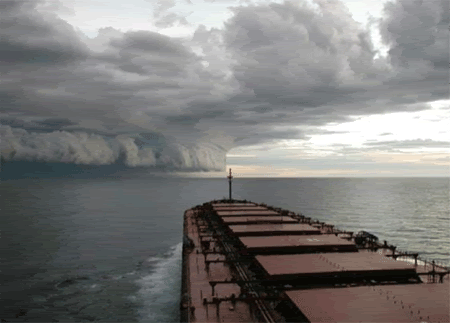
4. Warmer water and more hurricanesAs the temperature of oceans rises, so will the probability of more frequent and stronger hurricanes. We saw in this in 2004 and 2005.
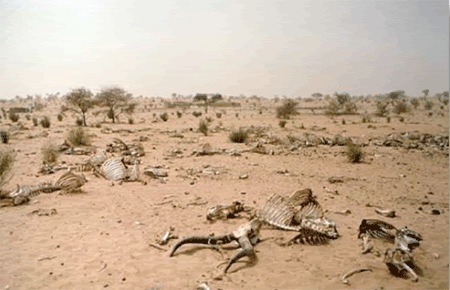
3. Increased probability and intensity of droughts and heat wavesAlthough some areas of Earth will become wetter due to global warming, other areas will suffer serious droughts and heat waves. Africa will receive the worst of it, with more severe droughts also expected in Europe. Water is already a dangerously rare commodity in Africa, and according to the Intergovernmental Panel on Climate Change, global warming will exacerbate the conditions and could lead to conflicts and war.
2. Economic consequencesMost of the effects of anthropogenic global warming won’t be good. And these effects spell one thing for the countries of the world: economic consequences. Hurricanes cause billions of dollars in damage, diseases cost money to treat and control and conflicts exacerbate all of these.

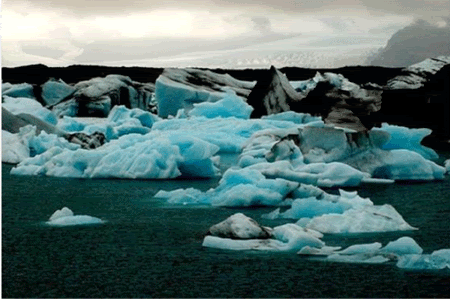
1. Polar ice caps meltingThe ice caps melting is a four-pronged danger.
First, it will raise sea levels. There are 5,773,000 cubic miles of water in ice caps, glaciers, and permanent snow. According to the National Snow and Ice Data Center, if all glaciers melted today the seas would rise about 230 feet. Luckily, that’s not going to happen all in one go! But sea levels will rise.
Second, melting ice caps will throw the global ecosystem out of balance. The ice caps are fresh water, and when they melt they will desalinate the ocean, or in plain English - make it less salty. The desalinization of the gulf current will “screw up” ocean currents, which regulate temperatures. The stream shutdown or irregularity would cool the area around north-east America and Western Europe. Luckily, that will slow some of the other effects of global warming in that area!
Third, temperature rises and changing landscapes in the Arctic Circle will endanger several species of animals. Only the most adaptable will survive.
Fourth, global warming could snowball with the ice caps gone. Ice caps are white, and reflect sunlight, much of which is reflected back into space, further cooling Earth. If the ice caps melt, the only reflector is the ocean. Darker colors absorb sunlight, further warming the Earth.
So what is the solution? Are we just being negative? Are there any positive effects of global warming? Will we continue to ignore the fact that we are the ones to blame? That we are the ones that will literally toast ourselves?
Think about this.
Move towards lessening fossil fuel consumption.
The Inconvenient Truth About Fossil Fuels
Fossil fuels, coal, oil and natural gas, are a non-renewable source of energy. Formed from plants and animals that lived up to 300 million years ago, fossil fuels are found in deposits beneath the earth. The fuels are burned to release the chemical energy that is stored within this resource. Energy is essential to modern society as we know it. Over 85% of our energy demands are met by the combustion of fossil fuels. These two pie charts show exactly how vital fossil fuels are to our society by showing how much of each energy resource is consumed.
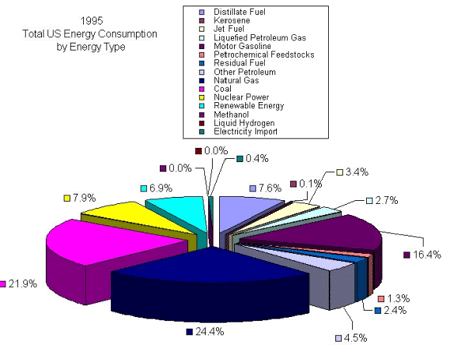
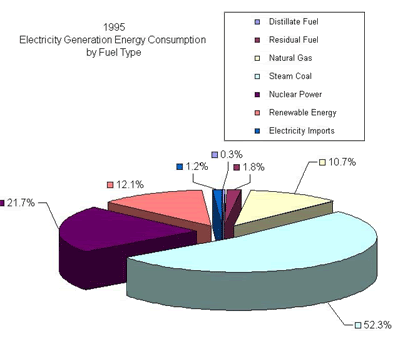
Formation
Going back to the earlier days of Earth, the plants and animals that lived then eventually died and decomposed. The majority of these life forms were phytoplankton and zooplankton. When these ancient ocean dwellers died, they accumulated on the bottom of a seabed; this is how a good portion of our fossil fuel reserves began. The actual transformation process of these prehistoric creatures is not known, but scientists do know that the pressure, heat, and a great deal of time go into the making of fossil fuels.
Geologists are fairly certain that the beds of organic remains mixed with silt and mud to form layers. Over time, mineral sedimentation formed on top of the organisms, effectively entombing them in rock. As this occurred, pressure and temperature increased, these conditions, and possibly other unknown factors, caused organic material to break down into the simpler form of hydrocarbons: chains of carbon and hydrogen ranging from simple configuration to complex compounds. Another affect of extreme pressure is that the oil and gas which are various mixtures of hydrocarbons migrate upwards to the surface. Exactly when in the conversion process and the nature of this migration is not known and is subject to conjecture.
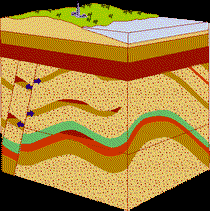
Oil and gas are found in the ground, not freely drifting up through the earth. This is because the hydrocarbons come across rock formations that they are unable to penetrate. Complex rock structures that effectively trap gas and oil are formed by tectonic plate activity, the same forces that shift continents. The most common formation that accomplishes this is called an anticline, a dome or arched layer of rock that is impermeable by oil and gas. Underneath this barrier, a reservoir builds up. An oil reservoir is not some vast underground lake, but rather a seemingly solid layer of rock that is porous. Oil fields have been found everywhere on the planet except for the continent of Antarctica.
These fields always contain some gas, but this natural gas, methane, does not take nearly as long to form. Natural gas is also found in independent deposits within the ground as well as from others sources too. Methane is a common gas found in swamps and is also the byproduct of animals' digestive system. Incidentally, Methane is also a greenhouse gas.
Coal is formed just like the other fossil fuels, though it goes through a different process, coalification. Coal is made of decomposed plant matter in conditions of high temperature and pressure, though it takes a relatively shorter amount of time to form. Coal is not a uniform substance either; its composition varies from deposit to deposit. Factors that cause this deviation are the types of original plant matter, and the extent the plant matter decomposed. There are over 1200 distinguishable types of coal. Coal begins as peat, a mass of dead and decomposing plant matter. Peat itself has been used as fuel in the past, as an alternative to wood. Next, the peat becomes lignite, a brownish rock that contains recognizable plant matter and has a relatively low heating value. Lignite is the halfway point from peat to coal. The next phase is sub bituminous. A shade of dull black, showing very little plant matter, this type of coal has a less than ideal heating value. Bituminous coal is jet black, very dense, and brittle. This type of coal has high heating value.
The main point of this is that all of these fossil fuels are made of hydrocarbons. It may come as a surprise that these two elements, hydrogen and carbon, can create many, many different compounds with unique characteristics. What makes hydrocarbons valuable to our society is the stored energy stored within them. This energy is contained in the atomic bonds. The original source of this energy is all the solar energy the prehistoric organisms trapped in their bodies eons ago. How do we make use of this bond energy then? We burn them.
Health Impact
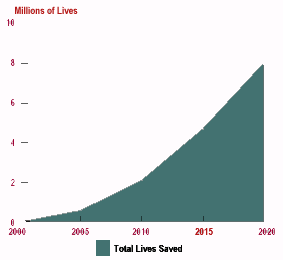
Air particles are deadly. The byproducts that form from the burning of fossil fuels are very dangerous. These small particles can exist in the air for indefinite periods of time, up to several weeks and can travel for miles. The particles, sometimes smaller than 10 microns in diameter, can reach deep within the lungs. Particles that are smaller than this can enter the blood stream, irritating the lungs and carry with them toxic substances such as heavy metals and pollutants. Over a lifetime of continued exposure, a person's ability to transfer oxygen and rid pollutants is impeded. Those affected could become afflicted with fatal asthma attacks and other serious lung conditions. the World Resources Institute reports that between the years of 2000 and 2020, 8 million deaths worldwide could possibly occur without changing present conditions. In 1990 alone, respiratory diseases were a leading cause of disabilities and illnesses worldwide. This is a global problem and requires a global solution. Because the contamination is growing at an exponential rate, minor reductions now will greatly reduce the number of lives lost in the future.
Saturday, January 24, 2009
Facts and Trivia
- Every hour, the energy in the sunlight that hits the surface of the Earth is enough to fulfill all of the world’s annual energy needs.
- Water power has been used for grinding grain for 2000 years.
- The largest wind turbine in the world is found in Hawaii. It is 20-storeys tall nad has a wingspan the length of a football field (90 meters).
- A wind turbine can provide electricity for about 300 homes.
- The first wind farm in Southeast Asia was built in Bangui, Ilocos Norte.
- Silicon from a ton of sand, used in photovoltaic cells (solar panels), provides the same energy with 500000 tons of coal.
- The country with the highest solar ownership rate is not in Europe, Americas, or Asia. It’s not even Australia. The answer? Kenya.
- If RE usage increases, the International Energy Agency expects the CO2 level to reduce by 50% by 2050.
- The residue of sugar cane can be used as biofuel.
- The US is the highest consumer of geothermal energy, followed by the Philippines then Iceland.
- 18% of automotives in Brazil use biofuels.
- The Earth has deep internal hot layers. The sun shines energy on Earth. Wind blows on different parts of the Earth at different times. The Earth is around 75% water. Yet only 0.8% of the world’s energy comes from these (geothermal, wind, ocean, solar).
The Real, the Factual, and the Painful
- Estimates by the International Energy Agency (IEA) show that as the global economy expands, the energy needs will grow by 55% from 2005-2030, or about 17.7 billion tons of oil equivalent (toe) from 11.4 billion toe.
- Carbon dioxide emissions are expected to go up to 42 gigatons (GT) in 2030 from only 27 GT in 2005, or up by 57%.
- A lot of land is needed for the constructions of wind farms. And to maximize the wind, wind farms are often built offshore. Global warming will one day raise water level and sink these offshore lands.
- Hydroelectric dams are one of the best alternatives to fuel, but it will affect the aquatic ecosystems and birdlife, have impacts on the river environment, and emit high amounts of carbon dioxide at construction.
Renewable Energy: It’s Simple
Oil is running out. CO2 levels are rising. The world is getting hotter. These are three statements that give problems to people from all walks of life today. Scientists, experts and others have proposed many solutions to solve these problems. Some are bizarre, some are sophisticated, yet some are simple. Just like renewable energy.
Renewable energy, what is it?
Short answer: Energy that can be renewed.
Better answer: Energy that came from natural sources and is naturally replenishing.
A lot of good things separate it from oil, making it the better energy source. It provides less pollution, it comes from many sources (water, sunlight, wind, etc.), and, as said, it is renewable.
Renewable energy (RE), comprising 18% of the world’s energy, has been seeing increase in its annual usage. Wind power grows at a rate of 30% per year. In 2006, the manufacturing output of photovoltaic cells (solar power) reached 2000 mega watts (MW). Government bodies are even promoting – and rewarding – the use of RE.
Examples:
- European Union agreed that by 2020, 20% of the energy source will come from RE
- With support from different countries and entrepreneurs, The World Wind Energy Association (WWEA), predicts that by 2010, the global total of wind energy will be 170000 MW.
- In 2008, President Gloria Macapagal-Arroyo signed the Renewable Energy Act, which promotes the use of RE and gives incentives to its promoters.
- The Cebu Declaration on East Asian Energy Security, which promotes energy security and the finding of alternatives (a.k.a. RE) to conventional fuel ,was a treaty signed by 16 nations.
Right now, the use of RE has been at a minimal, but nevertheless still significant. With the many different problems the world is facing today, the use of RE is expected to increase. Right now, only some types of RE are marketable, while the others are still under technological development (like photovoltaic cells). But when the needed developments are finished, all the types of renewable energy will be affordable.
It’s not forever that man will be mining oil. Carbon dioxide might reach historical peak the moment you wake up tomorrow. Global warming might have more negative effects than what we know of so far. These are three possibilities we might have to live with. Scientists, experts, you & I, we will all be affected. It will affect us in bizarre ways, in sophisticated ways. Yet it might change our lives in simple ways. Just like renewable energy. It’s simple.
Support the use of renewable energy. It’s better than you think and a lot simpler too.
Solar Energy : The Sunny Side to Life
Solar energy has existed ever since the sun was born. Humans have utilized this energy even years ago. For example, people placed glass in windows in order to trap the heat when the sunlight passed through. Solar energy is not a new thing. Its uses have just been continuously increasing and improving for years now. One of its new uses is to convert itself to electricity through solar panels.
How exactly does that work? Solar panels have silicon in them. Within the silicon, electrons move around when the sunlight strikes. They flow through the wires that were built within the panel, producing electricity. Solar panels have batteries within them, providing us with electricity at night or on cloudy days. Although, some researchers in the Idaho National Laboratory have come real close in producing a solar panel which would be able to absorb solar energy even at night. More information can be obtained in one of the links below.
A considerable amount of people have invested on solar panels. In the Philippines, it is slowly being introduced. For example, Boracay resorts have attended a workshop provided by Greenpeace about the benefits of solar energy panels, especially since global warming has started to affect it. Actually, a good deal of people may know all about solar panels now because of that crisis. Solar energy panels have become one of the best solutions to slow it down. The only reasons preventing people from investing them are because they are expensive at first and new. Buying them is expensive, however that is only in the beginning. Your electricity bill will decrease in the future, while you continuously contribute in saving the world. People’s habits are the one in need of change. If we do not invest on such a good opportunity, our potential for becoming a “profitable solar valley (Posadas, 2008)” will be put to waste.
Do not wait to strike till the iron is hot; but make it hot by striking.-William B. Sprague
Sources:
http://www.businessweek.com/globalbiz/content/oct2008/gb20081010_049382.htm
http://www.a-z.co.uk/how_do_solar_panels_work_163.htm
http://www.inhabitat.com/2008/02/04/solar-panels-work-at-night/
http://www.greenpeace.org/seasia/en/news/climate-friendly-boracay/
Friday, January 23, 2009
Stop. Look. Listen.
Well hello there, how’s life? Have you been too stressed lately, or are you always in a hurry? Well, now is the perfect time to stop everything you’re doing and just relax. Take a deep breath and worry about everything else later. But now, let us take a good look at our way of life and see if there is anything wrong with it. There doesn’t seem to be anything wrong? Look again.
Look.
Statistics show that only 27% of people in the whole world use or were familiar with biodiesel. Judging by this ratio it shows that majority of people use fossil fuels to power their vehicles and other household equipment. And why shouldn’t they? Petrol today is cheaper compared to biodiesel. It is reliable, efficient and much more marketable, whereas biodiesel is limited to only some cars, expensive, and is less known in some areas of the urban jungle. That is possibly why biodiesel is less renowned in areas of our country. Biodiesel is not as quite effective as regular fuel as many citizens have already followed the habit of using gasoline to fuel their cars. And suddenly converting their vehicles into ones that support biodiesel is either too expensive or too troublesome to the citizens today.
So now what? Is petrol a batter source of energy than biodiesel? It is still unclear, but petrol has many disadvantages to its users also. Petrol is one of the main causes of air pollution in the roads and streets of nearly every city. As petrol burns, its refuse is a gas that could be poisonous and very dangerous. Also, one large problem could also be the fact that the source of petrol is limited, and that we are slowly depleting the source especially for this generation.
Listen.
Today, the world is too dependent on fossil fuels for their number one source of energy. And if we exploit it too much today there will come a time when it would run out. So, I now say to you, that before that happens we should already prepare ourselves for the future. Even though it may be out of habit I encourage everyone who is reading this to support the use of biodiesel. Although it may be more expensive today, in the future it could, and should, slowly replace the same role of petrol in our lives today.
I hope you stopped, looked, and listened to this article, since in the end you would be the one who would benefit from all of this effort.